
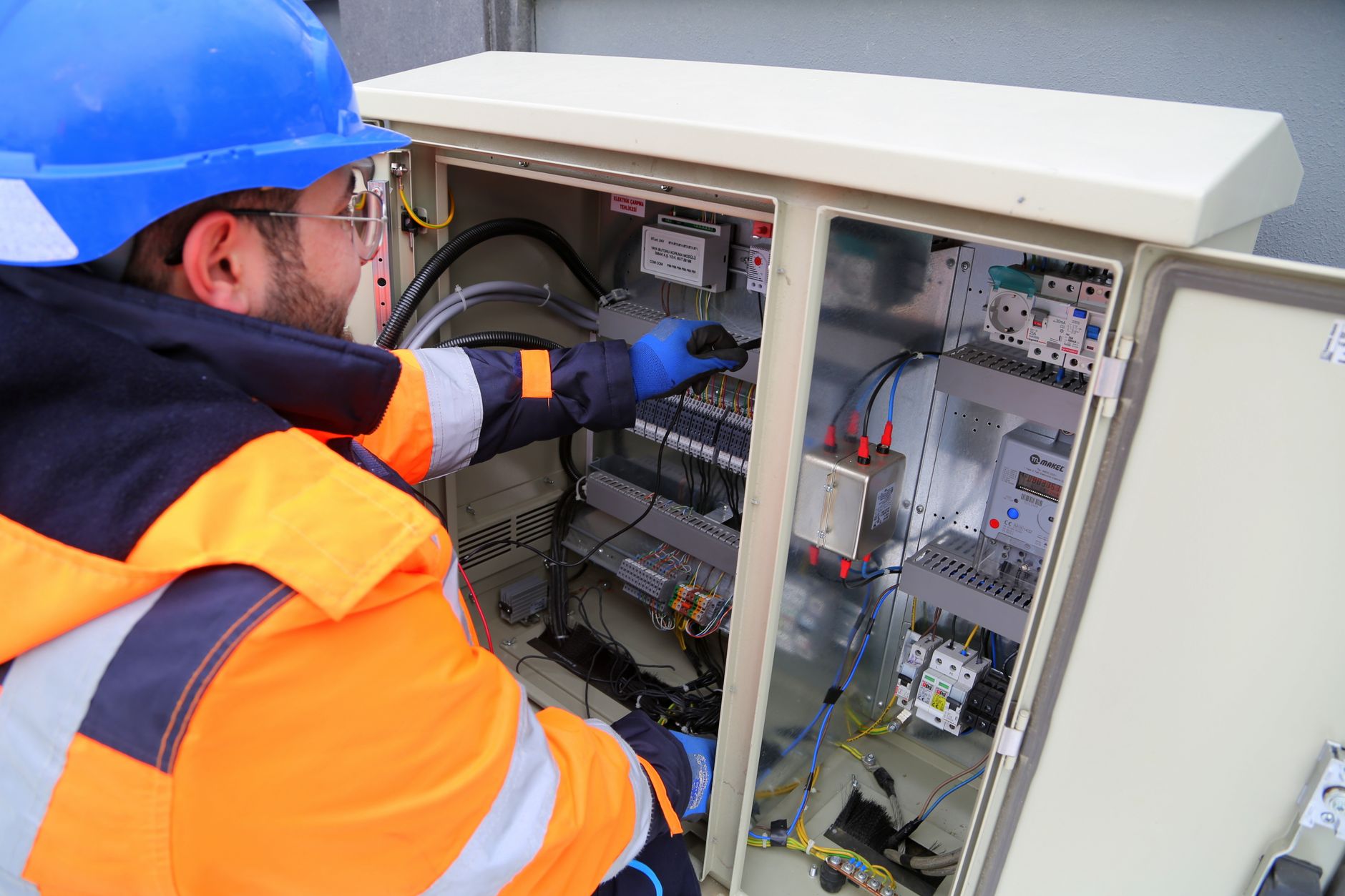
A breaker panel does one job: it takes the single large supply of electricity entering your home and splits it into smaller, protected circuits. Everything inside the metal box exists to make that division safe. Once you know the handful of parts involved, the idea of upgrading a panel becomes much easier to follow.
Panel Parts Explained
Start at the top, where the main breaker sits. This is the largest switch in the box, and it controls power to the entire panel. Flipping it off de-energizes the breakers below it (though the wires coming in from the utility on the line side stay live, which is why panel covers are work for professionals). The number printed on the main breaker, such as 100 or 200, is the amperage rating of the service.
Below the main breaker are the bus bars, two vertical strips of metal that carry the incoming current. Household power in North America arrives as two hot legs, and each bus bar carries one of them. Breakers snap onto these bars, alternating between the two legs. A single-pole breaker draws from one leg and supplies 120 volts. A double-pole breaker, which is wider and takes up two slots, draws from both and supplies 240 volts for appliances like dryers, ranges, and air conditioners.
Each branch breaker feeds one circuit: a set of outlets, a lighting run, a dishwasher. Its job is protection. If a circuit draws more current than its wire can safely handle, or if a fault creates a surge, the breaker trips and cuts power before the wiring overheats.
The neutral and ground bars are the metal strips with rows of screw terminals, usually along the sides. Neutral wires carry current back to the source. Ground wires provide a safe path for fault current. In the main panel, these two bars are bonded together and tied to the grounding system, such as a ground rod or the water pipe. In a subpanel, they must be kept separate.
How Amperage Limits Work
Amperage is the measure of how much current can flow at once. Your service rating is the ceiling for the whole house. A 100-amp panel can deliver at most 100 amps at one moment across all circuits combined, and a 200-amp panel can deliver twice that.
The key point is that the breakers added together can exceed the main rating without causing a problem. Circuits rarely run at full load simultaneously. Electricians use load calculations to estimate realistic demand based on square footage, major appliances, and heating or cooling equipment. If actual demand regularly pushes close to the limit, the main breaker may trip, lights may dim when large appliances start, or the panel may simply have no free slots left.
Modern households tend to draw more than older ones were designed for. Electric vehicle chargers, heat pumps, induction cooktops, and home offices all add continuous or heavy loads. A panel that was comfortable in 1975 can be stretched thin today, and a full panel often leads to risky workarounds like doubled-up breakers or overloaded extension setups.
What Changes When Upgraded
An upgrade replaces the panel enclosure, the main breaker, and the bus bars, and often the meter socket and service conductors if they are undersized. The most visible change is a higher amperage rating, commonly moving from 100 amps to 200. Just as important, the new box has more breaker spaces, so you can add dedicated circuits without crowding.
Older equipment is another reason to replace rather than patch. Some panels from certain manufacturers have well-documented reliability problems, and aging breakers can fail to trip when they should. A new panel also accepts modern protection devices, such as arc-fault and ground-fault breakers, which are now required for many circuits. A contractor like Fino Electric can inspect your existing setup and explain whether a service increase or a straight panel replacement fits your home. An Electrical panel upgrade usually also involves a permit and a utility coordination step, since the power must be disconnected while the work is done.
What does not change is the basic layout. The new panel still has a main breaker, bus bars, branch breakers, and neutral and ground bars. The difference is capacity, cleaner organization, and safer protection built to current code.
Your next step: open the panel door (not the inner cover), note the number on the main breaker, count the open slots, and bring that information to an electrician for a load calculation.